
Stretching for better breathing: why mobility matters
- helenhughesmarketi
- 6 days ago
- 4 min read
People often assume that breathing all about the lungs. In reality, it is a whole-body movement that relies on the ribs, spine, diaphragm, muscles and joints all working together.
That's why stretching and mobility work can play an important role in helping your breathing feel easier and more efficient.
At The Breathing MOT, we assess not just how someone breathes but how well their rib cage and thoracic spine move. These structures have a direct influence on your ability to take a comfortable, efficient breath.
The link between your spine and your breathing
Your ribs attach to your thoracic spine which is the section of your back that sits between your neck and lower back.
Every time you breathe in, your rib cage needs to expand in multiple directions. The ribs move upwards and outwards, while the diaphragm contracts and descends to create space for the lungs to fill with air.
If the thoracic spine becomes stiff, the rib cage often becomes stiff too.
This can make it harder for the rib cage to expand fully, meaning other muscles around the neck and shoulders may have to work harder to help you breathe. Over time, this can contribute to inefficient breathing patterns, feelings of breathlessness and unnecessary tension through the upper body.
Why mobility becomes even more important during exercise
At rest your body can often compensate for any restrictions in mobility.
During exercise, however, the demands on your breathing system increase significantly.
Your lungs need more air, your diaphragm needs to work harder and your rib cage needs to expand more effectively with every breath.
If movement through the thoracic spine and rib cage is restricted, your breathing system may struggle to meet these increased demands. This can contribute to feelings of breathlessness, early fatigue and the sensation that your breathing is limiting your performance.
Improving mobility doesn't increase lung size, but it can help ensure the breathing muscles and rib cage are able to work as effectively as possible.
Stretching can help your breathing
One of the reasons we use specific stretches in breathing rehabilitation is that different positions can encourage expansion into different areas of the rib cage.
For example, certain stretches create space through the lower ribs, while others improve movement through the sides or back of the chest.
As you breathe into these positions, you're not just stretching muscles - you're encouraging the rib cage to move more freely and helping the diaphragm work through a greater range of motion.
Many people are surprised to discover that simply changing their position can alter where they feel the breath expanding.
Breathing and stretching work best together
Stretching alone isn't usually the answer to a breathing problem.
Likewise, breathing exercises alone may have limited impact if the rib cage and spine don't move well.
The best results often come from combining mobility work with breathing awareness. By improving movement through the thoracic spine and rib cage while practising controlled breathing, you can help create the conditions for more efficient breathing mechanics.
Stretches you can try at home to support your breathing

1) Childs pose - focusing breath posteriorly to expand back and lower areas of lungs.
How to perform:
Start on your hands and knees.
Sit your hips back towards your heels and reach your arms forward along the floor.
Rest your forehead on the ground or a cushion.
Take slow breaths in through your nose, focusing on expanding your ribs into your back and sides.
Hold for 30–60 seconds, breathing steadily throughout.
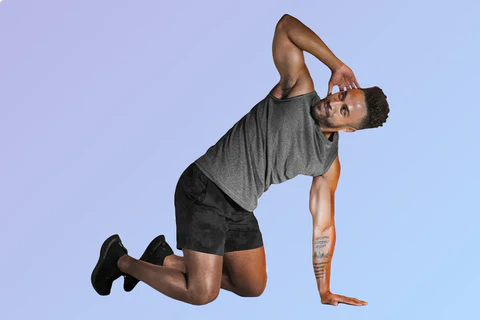
2) Thoracic rotations in kneeling - focus breath to uppermost lung when stretching up towards ceiling.
How to perform:
Start on your hands and knees.
Place one hand behind your head.
Rotate your upper body, bringing your elbow towards the supporting arm.
Then rotate in the opposite direction, opening your chest and bringing your elbow towards the ceiling.
Follow the movement with your eyes.
Repeat 8–10 times on each side, breathing out as you rotate open.

3) Pec stretch on foam roller - focus on gentle breathing control in this position. Great for stretching the front of the chest (pec muscles)
How to perform:
Lie lengthways on a foam roller so your head, spine and pelvis are supported.
Bend your knees with your feet flat on the floor.
Allow your arms to relax out to the sides in a comfortable position.
Keep your shoulders relaxed and breathe slowly into your rib cage.
Hold for 1–2 minutes, focusing on gentle chest expansion with each breath.

4) Thoracic rotation in lying - this stretch is great for doing some breaths directed in to the upper most lung as you reach round.
How to perform:
Lie on your side with your hips and knees bent.
Stretch both arms out in front of you at shoulder height.
Keeping your knees together, slowly lift the top arm and rotate your upper body, opening your chest towards the opposite side.
Follow your hand with your eyes.
Take a slow breath in as you open and breathe out as you return to the start position.
Repeat 8–10 times before changing sides.


Comments